
the vibe coding panic
is about the wrong thing.

👋 Hey, welcome to this week’s edition.
The vibe coding panic is everywhere, and it’s the same story every time, that of AI writing bad code, non-engineers shipping apps full of holes, and the flood is coming.
That story is true, but is not too interesting.
Veracode tested more than more than a 100 models and found that 45% of AI-generated code shipped with a security flaw from a well-known list.
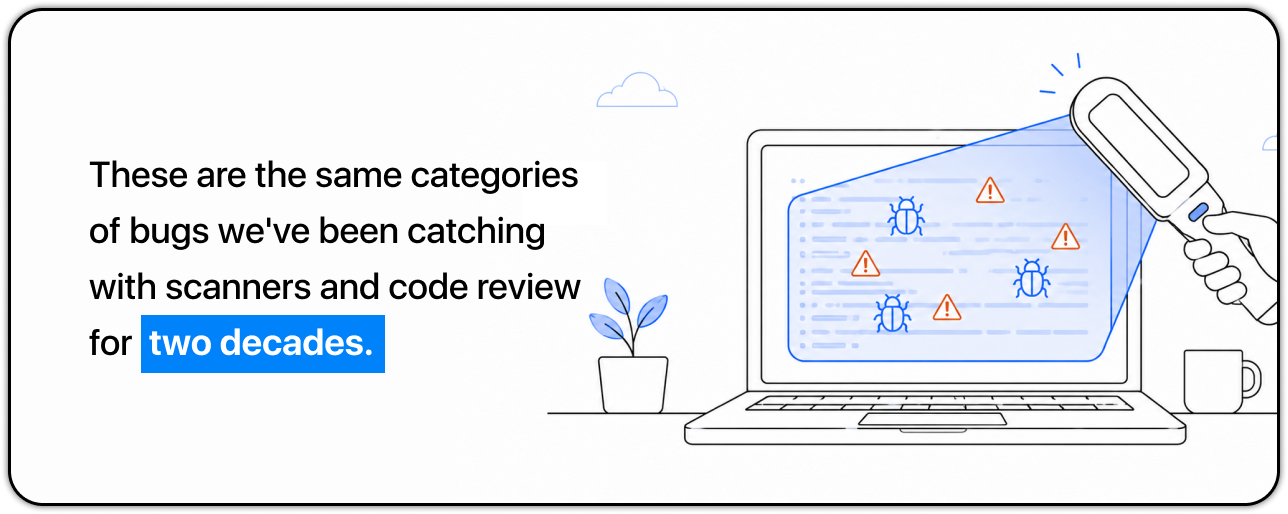
And you can tell how routine this has become, as I came across a 30-minute pre-launch security checklist for vibe coders the other day.
When the fix fits in a checklist, it’s a volume problem, and it gets absorbed by better platform defaults and a market that consolidates around a few well-funded players.
So the edition this week is that, people panicking about the wrong variable.
The flood of mediocre code is manageable. The other two things not many are talking about are new, and one of them has no fix.
1. The app no one owns
Harshil put it well:
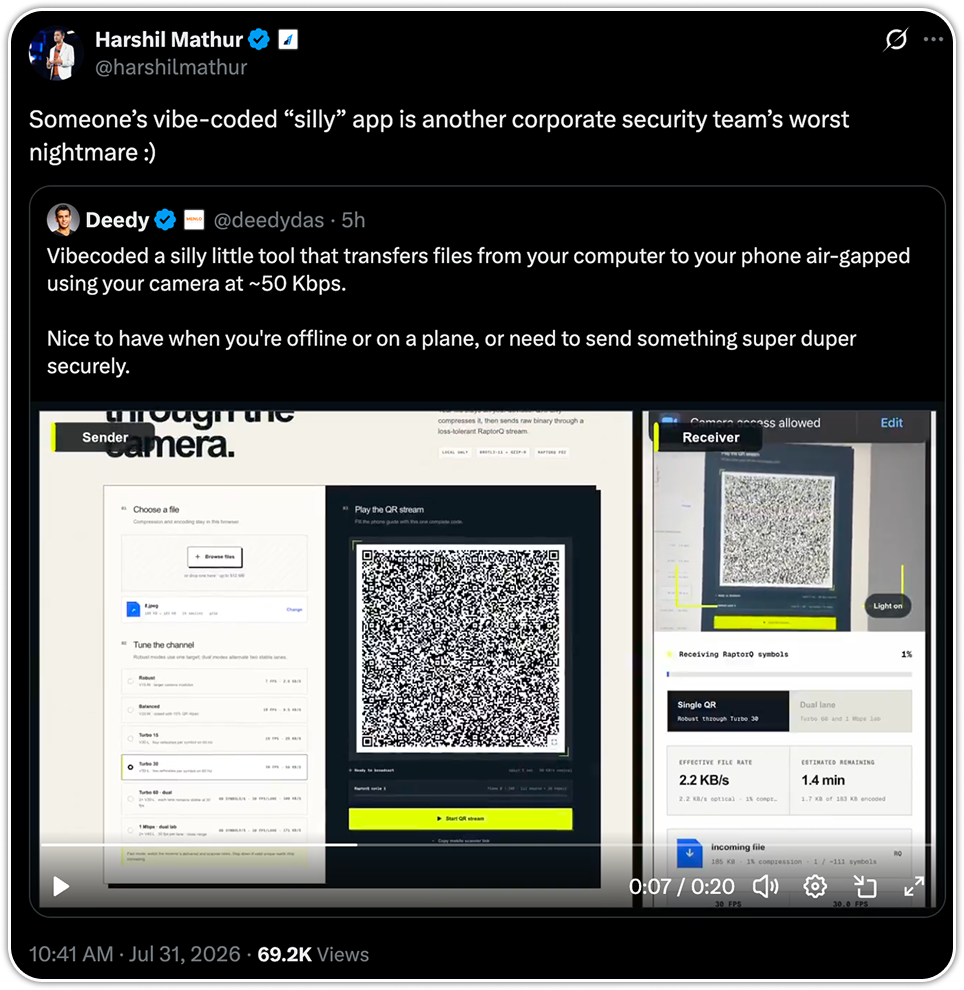
He was reacting to a weekend build that beams files from a laptop to a phone through the camera using QR codes. It has no network involved, which is why no monitoring software will ever see the files leaving.
That’s the visible version of the problem.
The vibecoded app that should worry you more was never the weekend hobby project.
It’s the internal tool a non-engineer at a 300-person company built to save their team an hour a day. It works, so people start using it.
Customer data drifts in because that’s where the work takes it.
Nobody logs it anywhere or adds it to an inventory, and the person who built it is the only one who knows how it runs.
When they leave, that knowledge leaves with them.
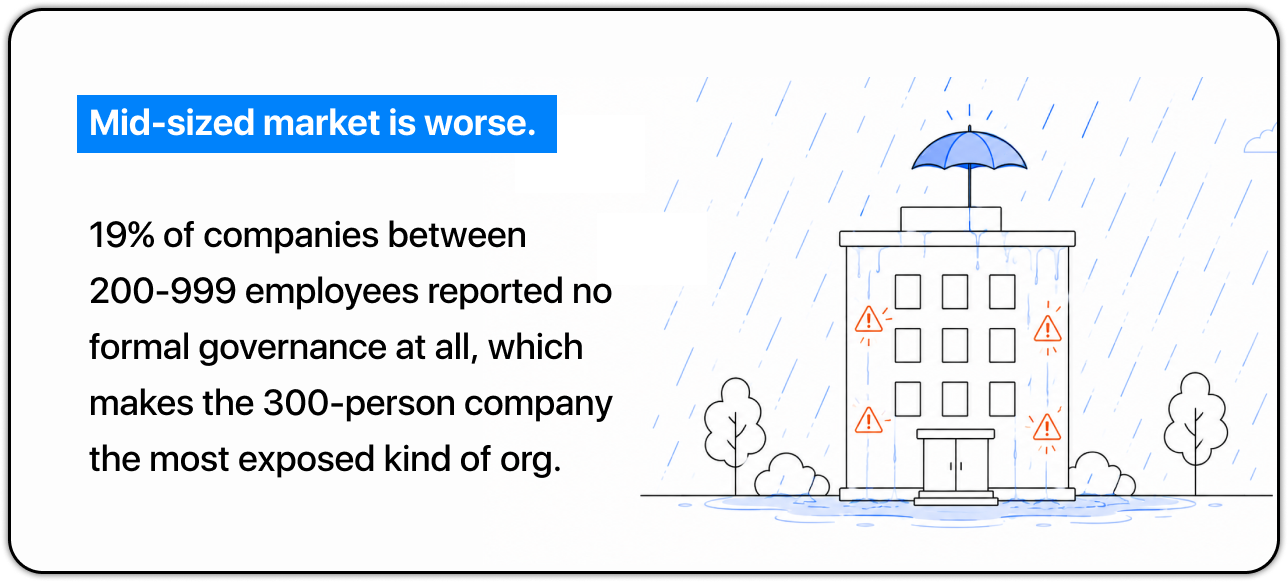
Retool surveyed 307 tech leaders about this, and they found that only 8% called their internal-tool governance strong, and just 5% said they were confident they could see every tool running across the company.
This is where I think product keeps getting the framing wrong.
Security teams ask whether an app is vulnerable, but the question product owns is: does this thing have an owner, a data classification, and someone accountable when it breaks?
That’s a process problem, and that is exactly what product teams are built to fix.
2. The bug with no patch
The second problem has nothing to do with code quality.
We’re handing AI agents credentials and the power to act, and we’re doing it on top of a type of weakness that has no fix anytime soon.
🥁🥁🥁
Prompt injection.
This can’t be patched, it’s not a bug.
A language model reads your instructions and everything else as one continuous stream of text. It can’t reliably tell the difference between what you asked it to do and an instruction an attacker hid inside the stuff it’s reading.
The security world’s official list of AI risks has ranked it the #1 threat two editions running, and says there may be no fool-proof way to prevent it.
Simon Willison, the researcher who coined the term "prompt injection" back in 2022, calls the dangerous combination a lethal trifecta: an agent that can see private data, take in content from outside, and send things out.
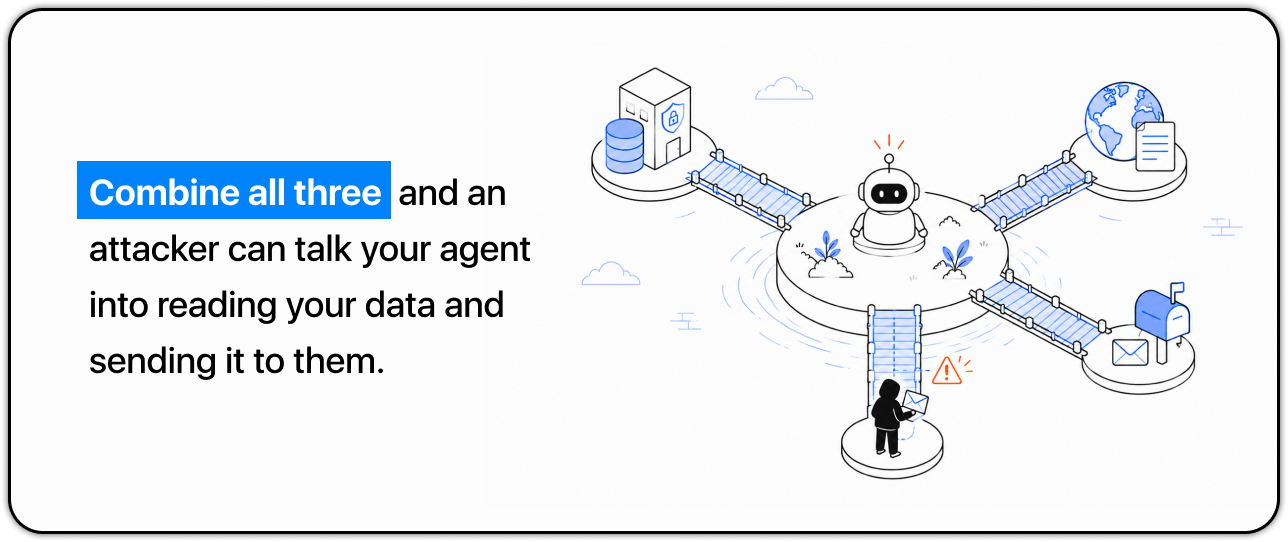
His advice to anyone waiting on the model providers to fix this is blunt: they are not coming to save you, so you have to design the combination out yourself.
And this already left the sandbox.
Microsoft patched a flaw called EchoLeak where a single crafted email made Copilot pull internal data and send it out with no click from the user.
Separately, security researchers showed how a rigged GitHub post could hijack a coding agent into leaking someone’s private code, and pointed out no patch could fix it because the problem is in how the whole setup works.
Every “AI writes bad code” vulnerability is a known category with known tooling, while this is a new category with no tooling, and only emerging as agent adoption picks up.
Bottom line
Your scanners were built for bad AI code. They weren’t built for an app nobody owns or an agent nobody scoped, and those are the ones that end up in the incident report.
So try this: list every internal tool at your company that was built with AI, and put a human name next to each one. If you can’t finish the list, you already know what to do this quarter.
Everyone’s testing with AI. Almost no one is testing the AI.

The team behind Netra shipped 25 AI agents across travel, customer service, scheduling, and voice transcription before building the product. Every one of them broke in production.
The customer service agent taught them the most. It told an angry user it would escalate the issue to a manager, which calmed them down, except the escalation never happened.
They found out a week later when the user came back angrier, and nothing had errored that whole week. Every dashboard said the agent was healthy.
Something worth doing this week: write down the 10 inputs where a wrong answer would hurt your users and what a good answer looks like for each.
That list is your first evals set and Netra was built to run that continuously.
It traces what your agent did on each run and scores it against your criteria, simulates the conversations your users will have, and red-teams it before someone else does.
Run one of those cases 20 times and you’ll know how often your agent keeps its word.
TPF readers get 3 months of Netra Pro free, and they’ll build your first eval set with you.
Bring the ten inputs. First 20 teams, open until August 15.
Upcoming Events
Founder of Founders: A Binny Bansal Exclusive
August 1 | Bengaluru
Register Here
Bits n Atoms: Build with OpenAI team
5th August | Bengaluru
Register Here
Basecamp | 6-12 August, Bengaluru
speakeasy w/ wispr flow
8th August | Register Here
Ship it | Replit x TPF
9th August | Register Here
Women in AI: In Conversation
10th August | Register Here
Feature Showcase Party by ElevenLabs
11th August | Register Here
Cafe Cursor
12th August | Register Here
Soundcheck: Basecamp Quiz Night
12th August | Register Here
Exclusive Jobs of the Week
Senior Product Manager
Lead Product Manager
Director Product
These and other roles open across top companies like Meesho, Google, Zomato & many more.
Reply and tell me how many you found. I've been collecting these, and the number runs higher than most people expect.
Cheers,
Suhas 👋🏻
The unowned internal tool is the one that shows up in my clients' audits as a data breach liability.
Indian startups routinely underbudget for prompt injection and security audits — they treat AI spend as build cost, not risk cost.
Financial planners can help tech leaders allocate for these unknowns before the incident report arrives.