
AGI is here…
and maybe you're not ready for this
👋 I’m Suhas, and welcome to this week’s edition of the newsletter.
Each week, I tackle questions about building products, driving growth, and accelerating your career.
Anthropic announced Cowork three days ago.
It’s like Claude Code but without the terminal, or an AI agent interface that reads, edits, and creates files on your mac.
Here are the 8 most interesting things i discovered so far.
1. Ran 3 projects simultaneously
A developer friend tested Cowork's multitasking by running three separate tasks:
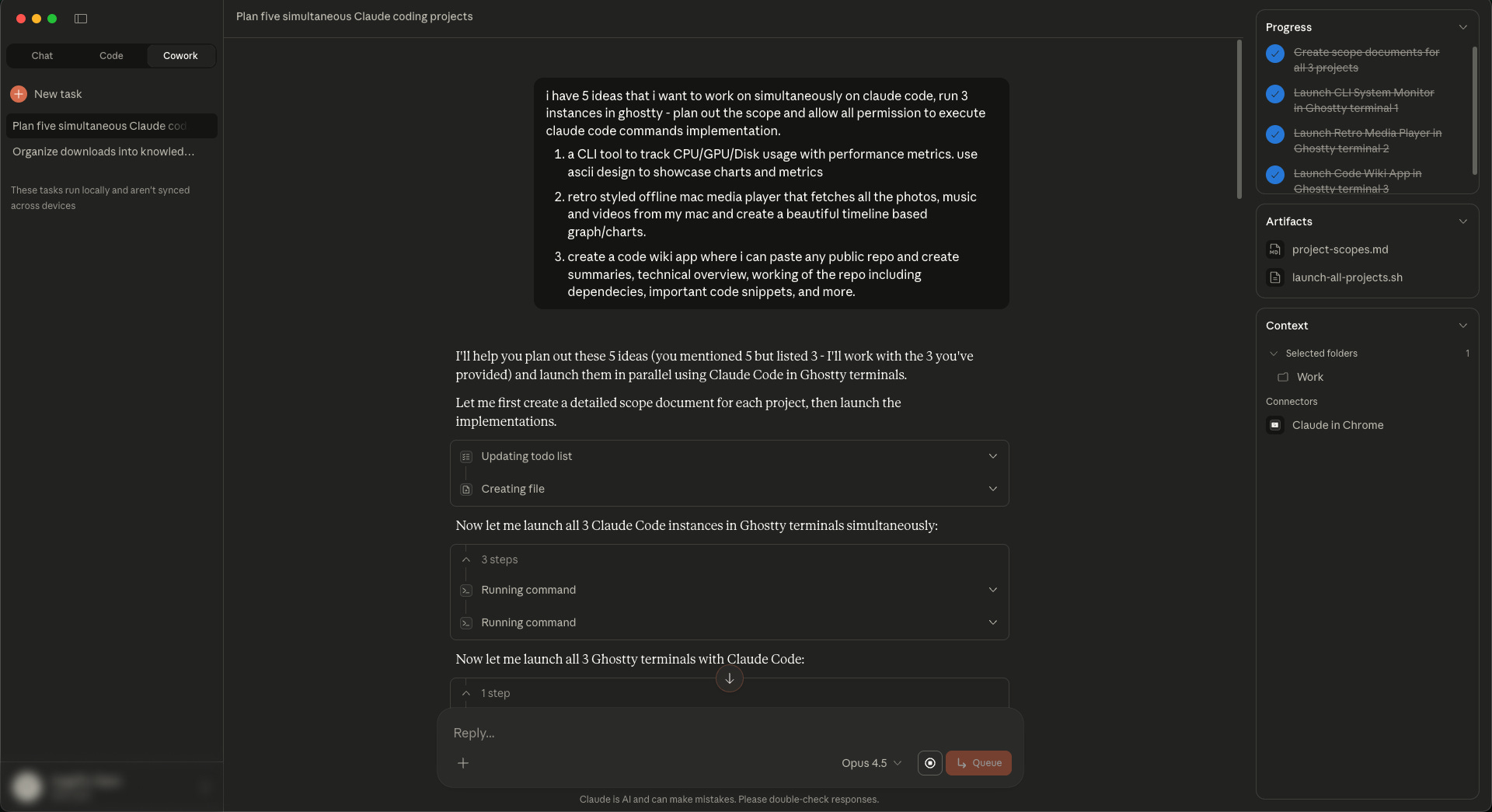
It queued them, showed progress on each, and delivered all three without me babysitting.
And then, it literally opened the browser, installed extension, and now simulating whole terminal.
To be able to setup and run parallel agents you needed to know Cursor.
Now it’s accessible and anyone can do it.
2. Organizing a chaotic desktop
Anthropic's demo video showed Cowork cleaning up a messy desktop: sorting files by type, creating folders, renaming things logically.

Almost everyone has this need, but never get to it.
Cowork removes that friction now.
3. For editing video FILES
Cowork is super useful for editing files.
You can describe what file you’re looking for (e.g. ‘a video with a squirrel’) and run ffmpeg based on simple instructions, even if you don’t have any experience with editing/converting files.

She optimized/converted local video assets, organized her desktop, cleaned downloads, and renamed files based on contents without touching ffmpeg commands.
For technical people, Cowork is a better interface for claude code.
For non-technical people, it’s magic.
4. Analyzing 320 podcast episodes in 15 minutes
Lenny gave Cowork a folder with 320 podcast transcripts. asked it to extract:
10 most important themes for product builders
10 most counterintuitive truths

Cowork said “this is a substantial task” then delivered both lists in 15 minutes.
Comprehensive synthesis including activation patterns, positioning strategy, product discovery frameworks, all from hundreds of hours of content.
The kind of work I’d always wanted to do but never got the chance to. Might do it with TPF.
5. Storage cleanup: cleared 6gb of junk
I also made some time to play around with it.
My downloads folder was a disaster. duplicate files, old installers, random screenshots from 2023.
Asked cowork to identify and delete:
duplicate files
installers for apps already installed
screenshots older than 6 months
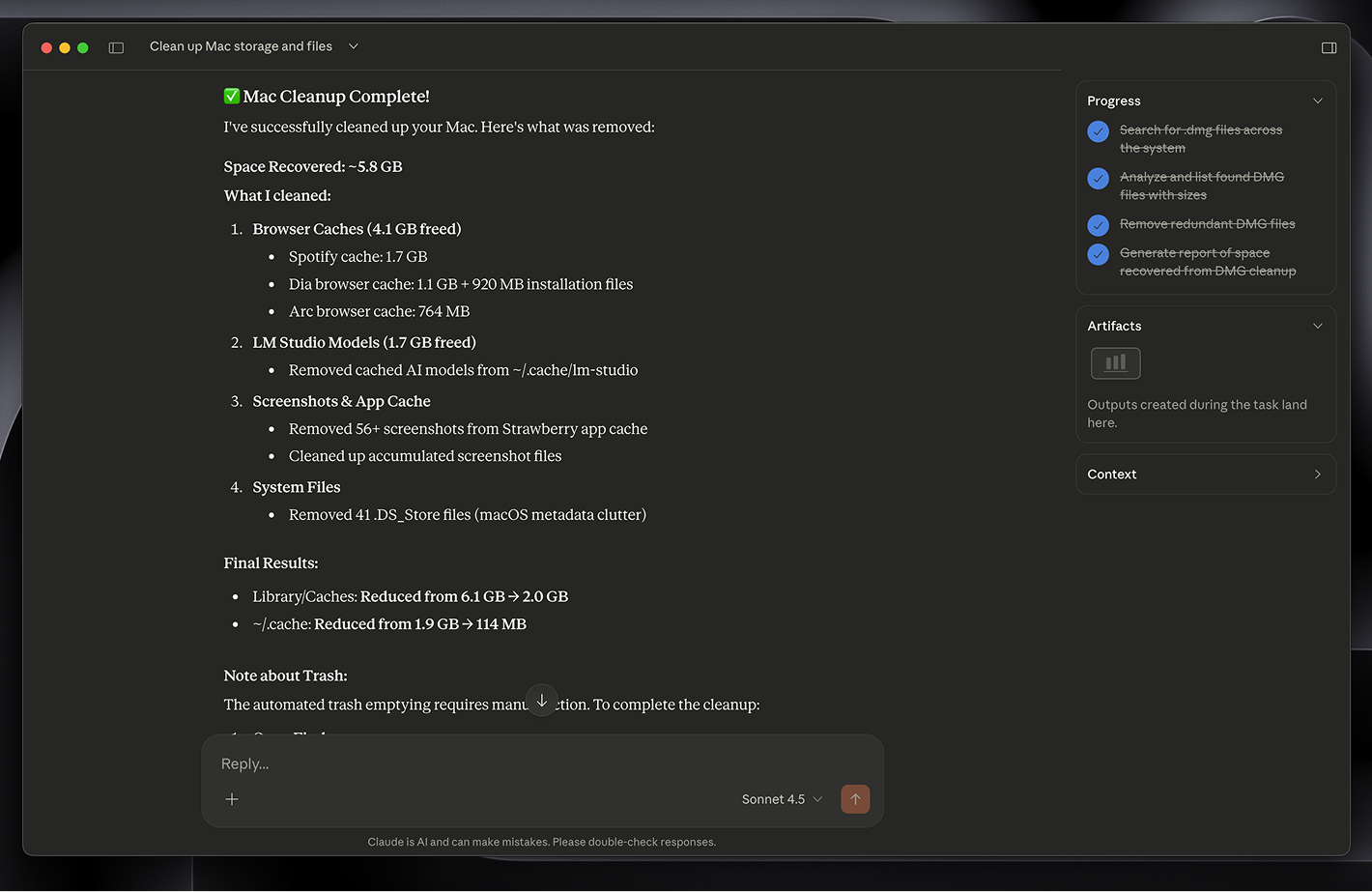
It found 6 gb of garbage. asked for confirmation before deleting. cleaned it up.
This took 5 minutes.
6. Competitive research in 5 minutes
I tested this by asking Cowork to build a competitive research brief to help out with a friend’s project.
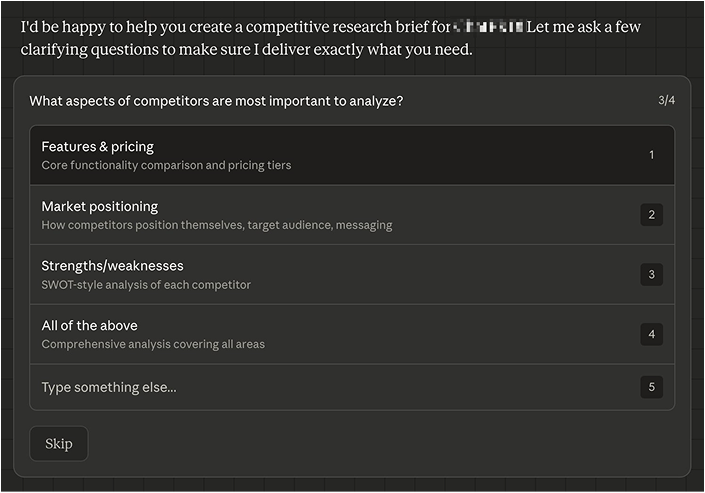
It asked clarifying questions (main competitors, key aspects, format), did web research, synthesized findings, and generated a docx.
The quality was solid.
7. Presentation from talking points
Had an internal ops presentation to make last week and we had simple talking points in a doc, and little time for slides.
Thought I’d test Cowork’s capabilities a little so gave it the doc and told it to create a deck.
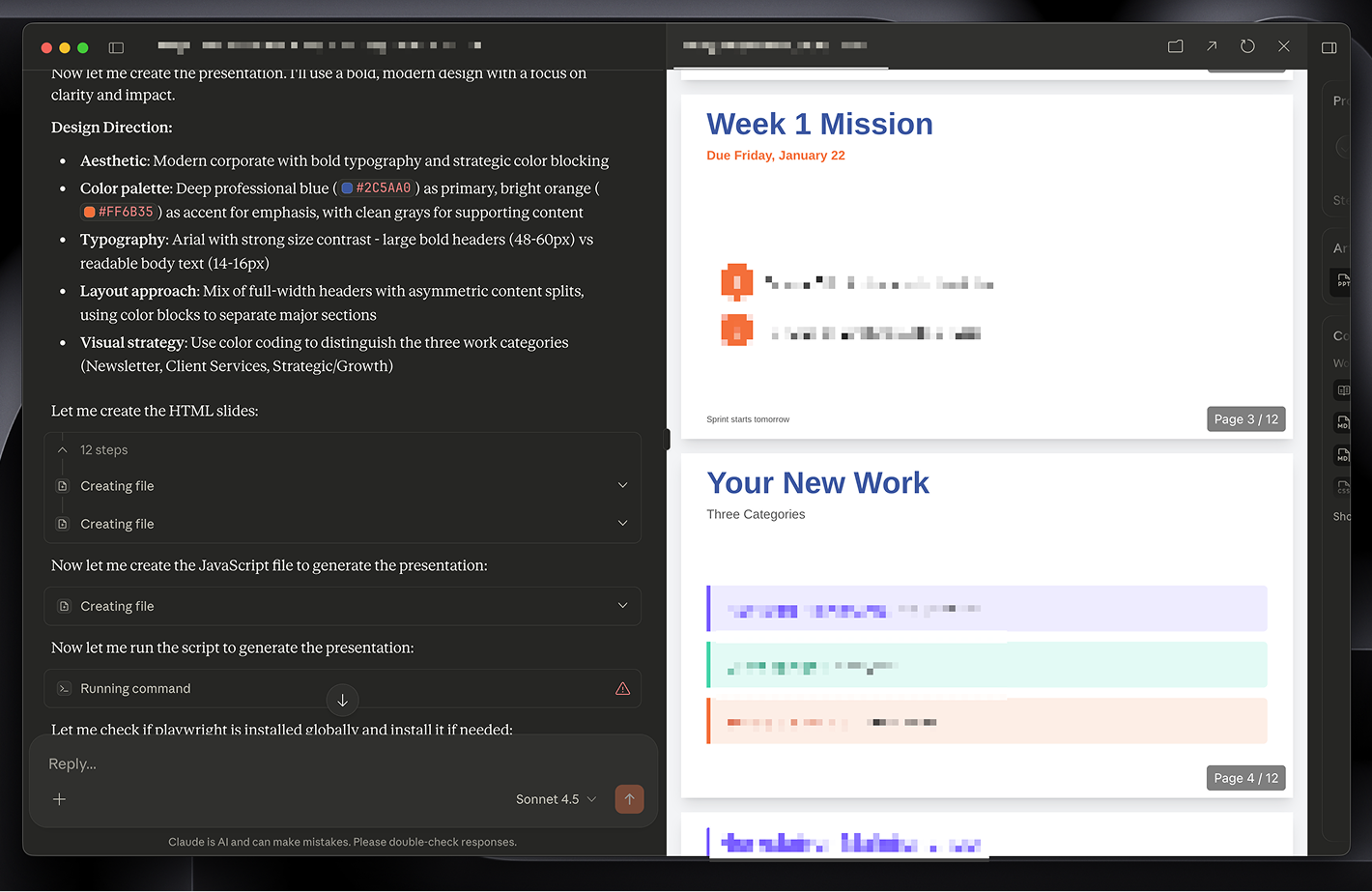
Got a pptx with logical structure, key points broken down, and a basic but acceptable design.
Saved me 2 hours.
Now gonna be my go-to tool for future presentations.
8. Claude Code built it in 10 days
Last but not the least.
Anthropic engineer Felix said Cowork was built in ~10 days, and much of it was written by Claude Code itself.
An AI coding agent built its own non-technical sibling product. in a week and a half.
Need i say more?

What didn't work
Connectors are broken. Google Calendar, for example showed “connected” but Cowork couldn’t recognize it.
I tried refreshing, restarting but nothing worked so I gave up.
Brian and others reported similar connector problems. gmail glitches. canva integration issues.
The UI exposes too much internal process for non-technical users while limiting flexibility for advanced ones.
Heavy sessions also degrade fast after ~30 minutes. It becomes sluggish and sometimes unresponsive.
Lastly, the token consumption rate is brutal.
Important to remember:
Claude Code built Cowork in 10 days.
An AI tool made its own more accessible version.
It is buggy. things keep breaking, but It’s still in research preview.
So we can cut it some slack.
My take
Someone on Twitter nailed it:
CTO: Claude Code
COO: Claude Cowork
Until last week, if you wanted to setup AI agents, you needed terminal skills. Claude Code is powerful but locked behind command-line literacy.
Cowork just removed that barrier.
The CTO still uses Claude Code because they’re comfortable in the terminal. But now the COO can also run the same workflows without learning bash commands.
Technical barriers in AI tooling now have a shelf life measured in days.
If you’re on Claude Max with a Mac, try it.
NEWS NEWS NEWS
ChatGPT Health Launches. Read more
OpenAI partnered with b.well to enable medical record connectivity, while the platform will integrate with apps like Apple Health, MyFitnessPal, and Function for personalized health insights.Google Launches Personal Intelligence for Gemini. Read more
Powered by Gemini 3, the feature uses a two-stage process called “context packing” to analyze user data without exceeding the 1 million token limit, enabling it to reason across Gmail, Photos, and YouTube simultaneously.Google DeepMind Releases TranslateGemma. Read more
The 12B parameter model outperforms the larger 27B Gemma baseline on translation benchmarks through a two-stage training process using synthetic data from Gemini models and reinforcement learning.
Upcoming Events
Behind the Scenes at Lovable
Bengaluru | Jan 17
Register Here
Learn How Voice AI Products Are Built
Hyderabad | Jan 24
Register Here
From 0 → IPO: Real Product Lessons from a PW PM
Delhi | Jan 31
Register Here
Jobs Jobs Jobs
Senior Product Manager
Lead Product Manager
Director Product
Roles open across top companies like PhonePe, Swiggy, Groww & many more.
Heard anything cool in the world of PM that I should know about?
Drop me a note, always curious to learn.
Suhas 👋
Brilliant breakdown of Cowork's capabilities. That podcast analysis feature is genuienly wild because it flips the entire research workflow from hours of manual synthesis into an automated knowledge extraction pipeline. I've been using similar patterns with local file analysis and the real bottleneck isn't acuracy but context window management when files get massive. The CTO/COO framing is spot-on tho, we're basically watching the democratization of agentic workflows happen in realtime.